|
|
|
|
|
|
|
Dear Wheatley
Wildcats and Other Interested Persons,
Welcome to the Wheatley
School Alumni Association Newsletter # 277,
The name of the “mystery movie”
about little league baseball that Steve Nelson (1958) and Michael Jablon
(1961) wrote about in Issue # 276 WAS, INDEED, “This Is Little League.” The “not” was a typographical error (or, more
accurately, a SNAFU). I apologize for the confusion.
ICYMI (In case you missed it)
News Report of Crash into North Side
Rick Jalonack (1966) Writes - “I attended North Side School a long, long time ago. It
was a wonderful place. Being interested in ‘Probability.” I wonder what is
the total number of autos that have crashed into North Side School since it
opened. In my opinion, the fencing will not deter someone who is intent on
scaling any form of fencing. I assume ALL the doors to the school are secured
and any approved person is closely monitored. Have all personnel been
instructed as to what to do in the event of an intruder? Is that
‘instruction’ reinforced on a regular basis? Is an armed guard present when
students are there? What I’m saying is there are many, many ways to protect
against unwanted entry. A fence may keep individuals out, but it will
certainly give the impression of an armed camp……or worse, a PRISON. Have all
the measures noted been enacted? A fence is the VERY last item that might be
considered and all of the other mechanisms should be deployed first.”
(((Art Engoron
(1967) Writes - I am unalterably opposed to guns in
schools!!!
From AI - “Research
tracking campus police behavior and use-of-force incidents in K-12 schools
and universities has documented numerous instances of severe physical injury
and occasional fatalities resulting from police intervention in student
fights or non-compliant behavior. There are also documented safety incidents
where armed personnel on school property have unintentionally mishandled or
discharged firearms, raising ongoing public safety debates regarding guns in
schools”)))
Rebecca Consolo Freer Freedman
(1968) Writes - “These are sad
times, indeed, when schools have locked doors and teach children the
procedures they need to adhere to if there is a “live shooter” in the
building.
Back when I was at North
Side, recess, field day, and even a fun walk at Christmas, to the house of my
fourth grade teacher, Mrs. Mingus (off campus!), were done without physical
boundaries. We felt safe, free and joyous. Aren't there enough fences and
walls in this world already?”
BTW, I read to children
in a neighborhood school twice a month as part of the ‘Read to Me Program.’”
Benjamin Ross (1967) Writes - “No fence & no wall! Put a row of bollards along
Hillside Avenue in front of the school. That will keep drivers out while
letting kids in.
No reason anyone should
drive fast on that two-lane road. Bollards right up against the roadway,
within a few inches, will slow down the drivers without actually obstructing
traffic.”
The attached picture is
more what I'm thinking of, for keeping drivers where they belong, not for
stopping terrorists.
|
|
Art Engoron (1967) Writes
- My esteemed classmate, Ben Ross, is
a traffic and transportation expert.
1976 - Dan Knudsen - “Don’t fence North Side in!!”
1962 - Howard Grindlinger, MD - “I just finished co-authoring an academic article on
Prions (a very interesting group of ancient enzymes and etiologies of rare
dementing disorders) with a friend and colleague. It passed first peer
review. If it passes the second peer review, it will likely get published. It
was a job with many headaches (and much learning) but no payment.
Rickover schools were our
answer to the onset of the ‘Cold War’ and to the Soviet Union’s Sputnik, the
first object made by humans to orbit the earth. The schools were as important
to President Eisenhower as the Interstate Highway System. He was more proud
of Rickover Schools (Hyman Rickover - Secretary of the Navy) than his golf
scores.
-I have a novel to
finish, as well.
-So, I remain busy with
writing long into my retirement.”
Howard explains Rickover
Schools:
“Wheatley came into
existence because it was part of Admiral Hyman Rickover’s (a Jew) effort to
overhaul the American Education system.
-Admiral Rickover began
his attack on the American Educational system in 1955, the same year he
launched ‘The Nautilus’, our first nuclear-powered submarine. Admiral
Rickover eventually went on to create the Navy’s Nuclear Submarine Force, and
he was its overall Commander.
In 1957, the Soviets
successfully launched Sputnik into orbit, with a payload of only 1.5 Kg.
Besides their rocket’s success, it proved that they had capabilities to
launch Intercontinental Ballistic Missiles (ICBMs) with guidance systems that
we had no clue yet how to build.
-Between 1957-1959, the
expensive Vanguard Missile Program FAILED 8/11 times. In 1959, Admiral
Rickover and VP Nixon (oddly) visited Soviet and Polish school systems- from
middle years to graduate studies. Regardless of what was staged or not, it
convinced Rickover that a stricter, more STEM (science, technology,
engineering, math) oriented academic structure was needed.
So were created,
nationwide, a group of schools to become the future of the next era of
progress. ’War will be won in the education battlefield,’ Admiral Rickover
was quoted as saying.
-Because of an increase
in population on Long Island, and with the offer of a site, Wheatley was
born!!! Teachers had to have master’s and even doctorate degrees. Dr. Ed
Thomas, our first Black Science teacher, held an ABD (“all but dissertation”)
Doctorate in Chemistry.
-It only took us from
1959 to 1973 to put a human on the Moon!!!
-I write this because the
views of Wheatley graduates of how Wheatley came to be are woefully
inadequate. We owe Admiral Hyman Rickover and President Eisenhower for our
excellence!
-Sadly, today, the ‘STEM’
program has fizzled like Vanguard rockets. I won’t list the crucial
consequence of ‘charter schools’, home schooling, and even politically
foolish Universities, Harvard being a wonderful but terrible example. Harvard
and its disgraced, now resigned, President provide a cautionary tale of how
far we’ve devolved from the Rickover System that brought us to the Moon, to a
United Culture of Excellence, and to Wheatley!!!
-This is a wonderful and
complex story to research. I hope that some of you pick up the gauntlet.”
1965 - Erik Calonius and Gibb Geery
Erik Writes - “Hello, Art.
Back in the 1950s, I
remember a baseball film being made on the diamond behind the North Side
School. I’m not sure if it was the Whitey Ford film—rather, I thought it was
a TV commercial. And I believe it starred Kenny Yagoda (1965).
Another comment: One of
our classmates recently recalled admiring the tall columns at the front of
the North Side School following the fire, and reading into them that they
represented stength in the face of adversity. It’s funny, because I was
standing there at one point as well, this as the demolition crane grabbed the
pillars and removed them. What struck me was the realization that the pillars
were not solid marble, as I had imagined, but merely hollow cylinders of
wood. My lesson, as a fifth grader, was, “don’t equate the outward appearance
of strength as strength to the core.”
I also want to remember
my good friend Gibb Geary. As kids, we played guitar together, often
disturbing the kids who were piously playing folk music, with our renditions
of the Beach Boys, Jan and Dean, Dion and the Belmonts, and The Ventures. We
skateboarded all over Long Island, even tackling the big hills in Great Neck.
We also played in a jug band with our good friend, and lovely person, Stu
Deaner, who died in a car wreck a few years later. We surfed Gilgo Beach, and
once we were picked up by the highway patrol hitchhiking along Meadowbrook
Parkway. We had to go to court, and Exhibit One was our hand written sign,
“To the Beach.” They let us go, and we sang “God Bless America.”
When I graduated from
Ohio Wesleyan, I returned to Long Island to find Gibb there, as lost for
direction as I was. Fortunately, a college friend called. He had moved to a
place called Cambridge, Mass. I went up, loved it, and returned to Long
Island. Gibb and I got into my car (a 1958 English Ford) and moved up there,
finding a cheap apartment on the poor side of Beacon HiIl. I got a job
working on a printing press near Fenway Park (the 5 pm to 4 am shift) and
Gibb joined me.
Things were good, but
then Gibb lost the job. He ended up driving a delivery van for a grocery
store. One day, he came home and told me that the engine was talking to him.
He had become schizophrenic. In the ensuing years, we lost contact. The last
time I saw him, he was living in a dark old apartment. It had a wrought iron
frame bed. On the nightstand was a stuffed black raven on a perch and next to
it, a handgun. About 15 years ago, he somehow found me living in Charleston,
SC. After that, we spoke frequently. I learned all about his life as a
homeless person. His girlfriends. His conversion to the Muslim religion, of
the change of his name to Saleem. Of the attempts by the city to evict him.
Of the fire that burned down part of the house he was in, killing one of the
other men who lived there. I always spoke to Saleem as a friend, a
buddy—never as anyone who deserved my pity. I offered to lend him money. He
refused. One time I sent him a check for $400. He had nothing, but he
returned it. When he was dying, I was relieved when his brother Scott told me
that his friends from the Muslim Brotherhood sat over him and took care of
him. And when he died, they washed his body, dressed him in white, and laid
him to rest with their prayers.
Gibb, as I hope you know,
was handsome, a gifted artist, and brilliant beyond my ability to keep up.
The cartoons and sketches he passed over to me in geometry class were why I
still don’t know obtuse from acute, and I never will.
I wish that I could say
that, looking back, I‘m satisfied with the help I provided for Gibb, but I
know I didn’t do enough. It’s hard.
I remember when he was
being evicted, I told Saleem that if the state forced their way in, we were
going to get Judge Arthur Engoron (1967) to call those bastards and
say, “He’s not some bum. Get your hands off him. He’s one of us.” It never
came to that, but he was one of us.
Erik
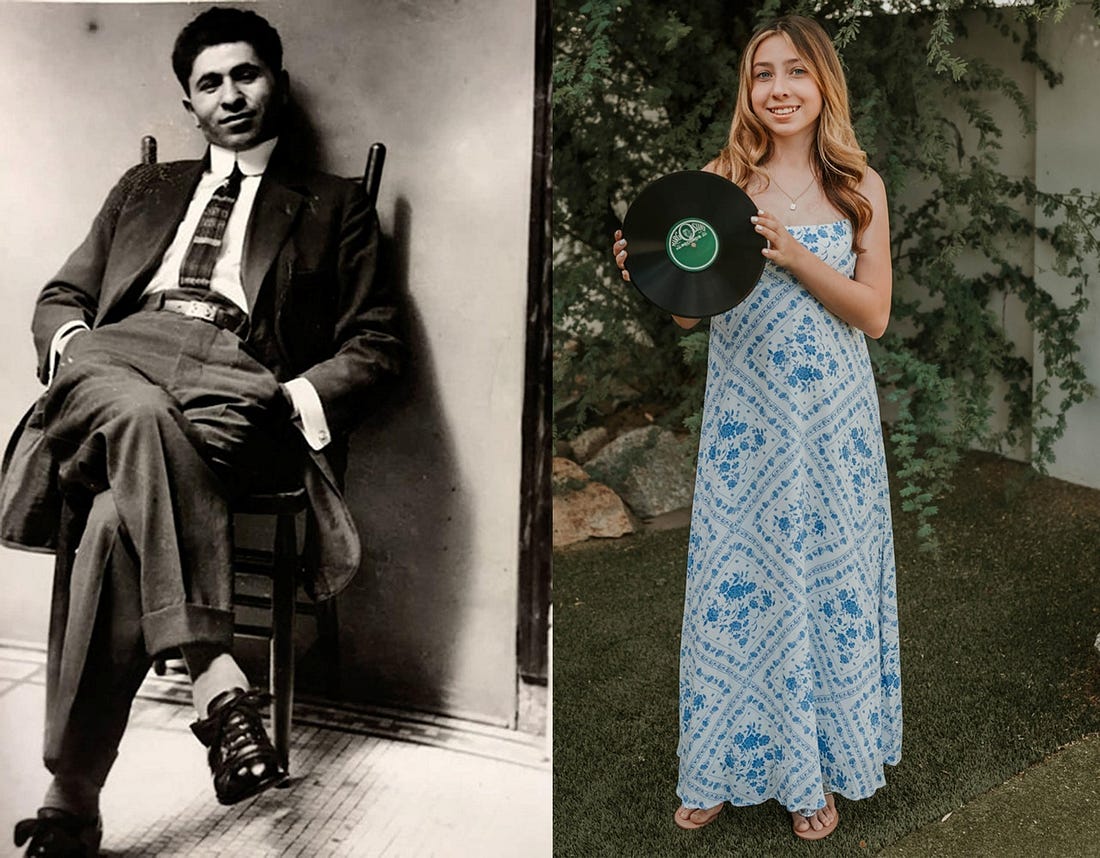
1967 - Linda Caterino - “My 12-year-old granddaughter, Alessandra Stoutner, has
had her first publication in the Newsletter of the Armenian Museum of
America. She wrote about her great-great-grandfather, Vartan Margosian, who
was a well-known Armenian musician. His family was killed during the Armenian
Genocide in 1915, but he himself had already immigrated to New York, in 1908.
While Vartan was employed as a photoengraver, his passion was music.
He opened a small,
privately-owned record company independently to record and release
traditional Armenian music (“A&T Records,” later “Margosian’s Records”).
He recorded at least 66 records and over 122 songs with 100 to 300 copies per
record release. Vartan was known as the “Nightingale of Kharpert” because he
played, sang, wrote, and recorded traditional folk music from the Kharpert
region of present-day Turkey. Vartan sang and wrote lyrics in Armenian, the
Western Armenian dialect, Turkish, and Kurdish. He played violin and the oud
(similar to a guitar). Vartan played and recorded over the Gimbels Department
Store Radio Station in 1924 and 1925. Some of Vartan’s songs were original
pieces, while others were traditional songs from Armenia. Vartan’s music had traditional
folk melodies and tempos and included multiple instruments, such as dumbaks
(drums), piano, clarinet, mandolin, oud, Kanon (like a zither), and violin or
fiddle. His music has been compared to Appalachian Blues music because it is
folk music with some elements of improvisation with a broad emotional range.
Alessandra has inherited some of Vartan’s talents. She sings and plays piano
and electric guitar.
You can hear the
recordings and read Alessandra’s essay at this site:
Vartan Margosian Armenian Recordings
|
|
Portrait of
Vartan Margosian (left) and Alessandra Stoutner (right).
1968 - Claudia Aufhauser - Rebecca
Consolo Freer Freedman (1968) Writes - “I was saddened to read about the passing of Claudia
Aufhauser in 2014. She and I were very good friends in 7th grade and spent
lunch time having long talks about life, family, boys ( I had a crush on her
older brother Keith), and the world in general. I always wondered
where she went. I will miss her.”
1968 - Bruce Ellison - “Hi Arthur, I still have a lot of memories (of all
types) re my Wheatley experience. I wish my grandkids could benefit from a
quality early education like we received and took off from.
I was one of Leonard
Peltier’s attorneys for the past 50 years, through his trials
and appeals, where there were convictions. I was also mostly a briefcase
holder for his co-defendants, who were found not guilty by reasons of
self-defense in the deaths of the two FBI agents on the Pine Ridge Indian
Reservation in 1975. That was my interesting first 2 years of practice.
(((According to
Wikipedia, “Leonard Peltier (born September 12, 1944) is a Native
American activist and member of the American Indian Movement (AIM) who was
convicted of murdering two Federal Bureau of Investigation (FBI) agents
in a June 26, 1975, shooting on the Pine Ridge Indian Reservation in South
Dakota.”)))
1975 - Frank Engoron
|
|
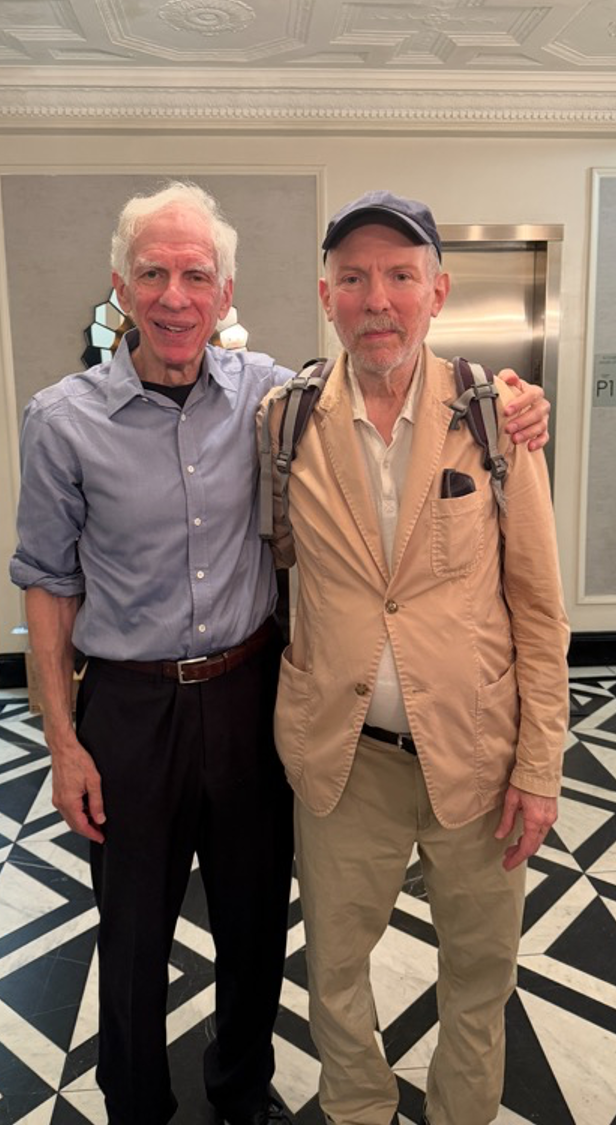
L-R - Art
Engoron (1967) + Frank Engoron (1970) - West End Avenue Lobby, July 2026
1984 - Scott Barshay -
Prominent Attorney
|
|
Career at Paul
Weiss discussed at length in New York Times Article:
Scott Barshay 1984 - Man in the News
Faculty (Stephen Ehre) - ❤️
1962 (Howard Grindlinger) - “Many thanks for your extensive work to connect
Wheatleyites over these many years.”
1964 (Richard Ilsley) - ❤️
1964 (Steve Simmons) - ❤️
1965 (Mitch Ditkoff) - ❤️
1965 (Judy Lutrin Sidran) - “Thanks for keeping us all connected.”
1966 (Richard Jalonack) - ❤️
1967 (Jill Simon Forte) - Thanks. As usual, I get to read names of some people I
had long forgotten about, which makes me smile .” ❤️
1968 (Rebecca Consolo Freer Freedman) - “Many
thanks to both you and Keith for the work you do on the Newsletter.❤️”
1968 (Bruce Ellison) - “Thank you for the Wheatley Newsletter.”
1970 (Mitch Shapiro) - “Enjoying the hard work you put into making the
Newsletter the success it is….”
1972 (Debra Soffer Beilin) - ❤️
1974 (Melanie Artim) - ❤️
1974 (Bob Berta) - “I love the Newsletter.”
1977 (Peter Fitzpatrick) - “Thank you, Art. I appreciate the Newsletters.” ❤️
1996 (Joshua Effron) - ❤️
Non-Wheatley (MBDE) - ❤️
Unknown (Ellen Jacobs) - “Thank you for compiling the Wheatley Newsletters and
sending them out. I am sure that is a tremendous amount of work.”
All underlined text is a
link-to-a-link or a link-to-an-email-address. Clicking anywhere on underlined
text, and then clicking on the text that pops up will get you to your on-line
destination or will address an email.
Thanks to our fabulous
Webmaster, Keith Aufhauser (Class of 1963), you can regale
yourself with the first 275 or so Wheatley School Alumni Association
Newsletters (and much other Wheatley data and arcana) at our website:
The Wheatley School Alumni Association Website
Also thanks to Keith is
our search engine, prominently displayed on our home page: type in a word or
phrase and, wow!, you’ll find every place it exists in all previous
Newsletters and other on-site material.
I edit all submissions,
even material in quotes, for clarity and concision, without any indication
thereof. I cannot vouch for the accuracy of what people tell me, as TWSAA
does not have a New Yorker style Fact-Checking Department.
We welcome any and all
text and photos relevant to The Wheatley School, 11 Bacon Road, Old Westbury,
NY 11568, and the people who administered, taught, worked,
performed, and/or studied there. Art Engoron, Class of 1967
That’s it for The
Wheatley School Alumni Association Newsletter # 277. Please send me your
autobiography before someone else sends me your obituary.
Art
|
|
|
Arthur Friedrichs Engoron, Class of 1967 |