|
|
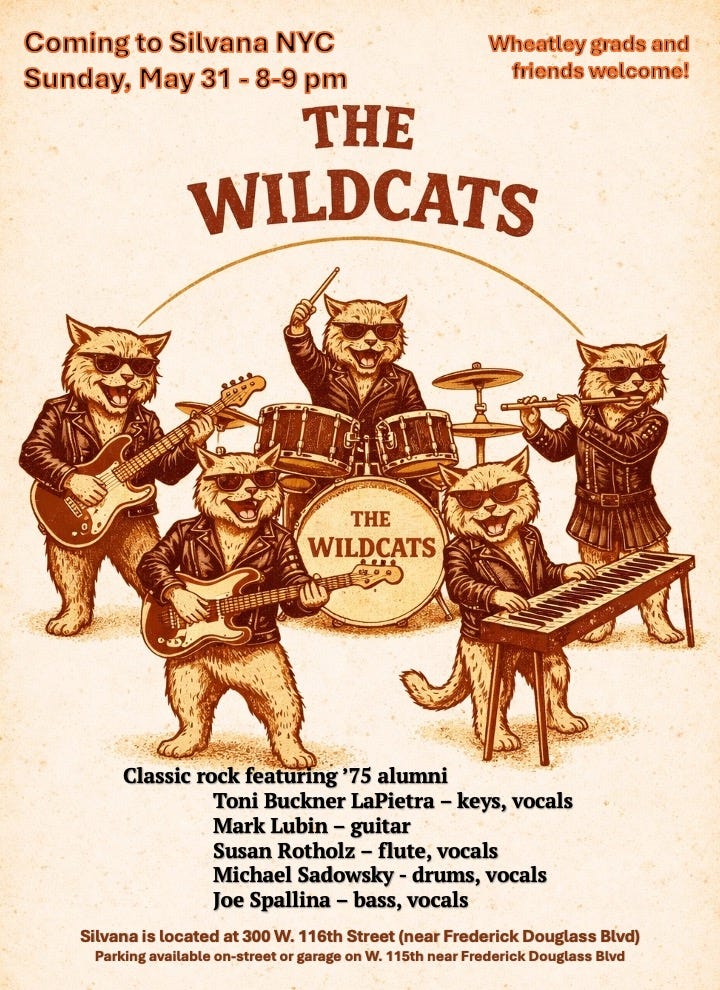
The Wheatley School Alumni Association Newsletter # 264Wildcat Band Performance; Rich Weissman's Shindig; Wildcat Baseball, by Bruce Artim; Jack Wolf; Larry Shiller; Bradley Feuer; Critics Corner (new feature) (Review of Broadway's "Death of a Salesman")Dear Wheatley Wildcats and Other Interested Persons, Welcome to the Wheatley School Alumni Association Newsletter # 264 Wildcat Band to Play at Wheatley Reunion in Manhattan - 5/31/2026The Wildcat band that played at the Class of 1975’s reunion weekend last October wanted to keep the fun going and give the New York area Wheatley community an opportunity to get together. They will be playing at Silvana in Harlem on Sunday, May 31 (a week after the Memorial Day weekend) at 8pm. Silvana has good food and is big enough to accommodate plenty of Wheatley graduates and friends from all classes. No cover, minimum, tickets or RSVP’s necessary. More details below.
Wheatley Wildcat BaseballJon Sporn (1971) Writes - “Thanks to my classmate Bruce Artim for his memories of Jack “Cat” Davis. Although I don’t remember that specific episode, I do remember Mr. Davis managing to keep us smiling through the ups and downs (mostly downs) of that season. Also, thanks to Bruce for his characterization of my baseball skills as “good-field, good-bat.” He neglected to mention another key component: terrible arm. During a brief trial at third base, Cat made me see that this was not the position for me by describing one of my throws to first base as having ‘measurable hang time’. That season was clearly the high point of my organized athletic career. At Yale, I was on the freshman baseball team (the coach was Ken MacKenzie, former pitcher for the original Mets), and I was primarily a bench-warmer. I don’t think that I would even have tried to squeeze that into my schedule without the fond memories of Wheatley baseball. Graduates1967 - Jack Wolf - “I was surprised to get a Facebook page post from my sister from a Williston Park realtor with our old home, 168
Glenmore St. East WIlliston, listed for sale for 1.4M dollars. This was the
home that my parents bought in 1953 for $21,000 with a post-war GI loan. At
that time, my father was a bookkeeper, not aCPA, just kept the numbers at the
Engineers Country Club, where we were all busboys. I was one of four
children; thus, firmly middle class, maybe towards the upper, as was that
neighborhood West of High Street along Bengeyfield Drive, where my cohort, Larry Baum,
Richard Friedman, and Art Engoron (all 1967) cavorted. Here is the listing for the home for sale. Facebook”
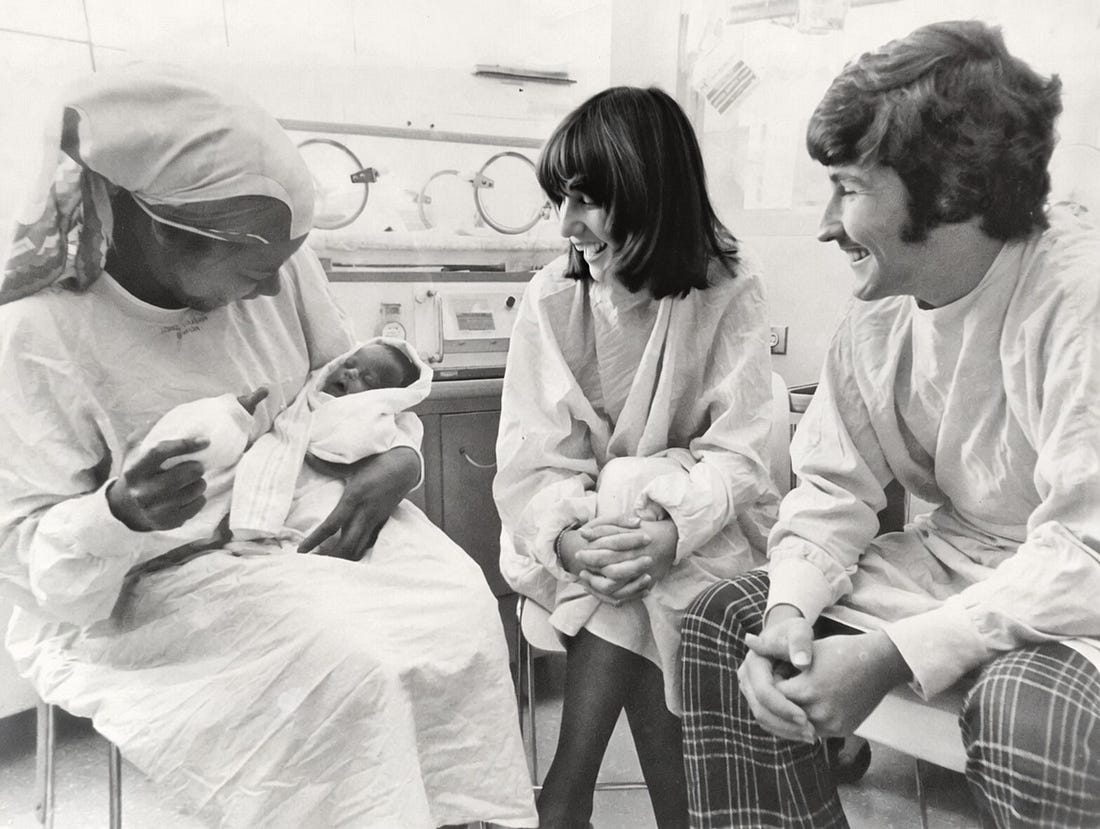
Larry Shiller after Wheatley and MIT 1978 - Bradley Feuer - The Wheatley School Fair of 1976, and The Letter That Nearly Derailed His Early Graduation Bradley Writes - “As the 50th anniversary of the Wheatley School Fair ’76 approaches, I find myself thinking back to how that memorable event came to be. Early in my 10th‑grade year, I asked someone in the administration why the school hadn’t held a fair since I was in 8th grade. The answer was simple: no students had shown interest. If I thought there should be one, I was told, then I should organize it. So I did. I was appointed ‘chairman’ of the Fair and paired with Herbert Wheeler as Faculty Advisor. Our first task was choosing a beneficiary for the funds we hoped to raise. I recommended the newly planned Children’s Medical Center at Long Island Jewish Hospital, and the idea was quickly embraced. Beyond securing rides and booths, I decided to pursue a more ambitious goal: soliciting corporate donations. I wrote to the presidents and CEOs of major companies, asking them to support our effort. To my surprise, nearly every business responded—some with contributions, the rest with polite declines. Only one company remained silent, even after a follow‑up letter: McDonald’s. When the Fair concluded, we had raised nearly $15,000 (an extraordinary sum in 1976) for the new children’s hospital. Flush with idealism (and the confidence only a fifteen‑year‑old can muster), I wrote a third letter to the president of McDonald’s. This one was…less diplomatic. A few days later, as I was cleaning out my locker for the summer, I felt a tap on my shoulder. I turned to find Mr. Wheeler—normally calm and soft‑spoken—red‑faced and furious. “YOU!” he shouted. “DID YOU WRITE A LETTER TO THE PRESIDENT OF MCDONALD’S?” I admitted I had. He informed me that the president of McDonald’s had called Principal Wathey directly, and that I was “in big trouble”—so much so that my plan to skip 11th grade and graduate early might be in jeopardy. He marched me to the principal’s office. Mr. Wathey, far calmer, asked what exactly I had written. I explained that I had informed McDonald’s of the Fair’s success, the $15,000 raised, and the fact that every company had responded except theirs. Then came the part that caused the trouble: I had added that McDonald’s apparent disinterest suggested they cared more about making money than supporting the nation’s youth, and that the entire Wheatley student body was now aware of this and would no longer patronize any McDonald’s franchise. Apparently, my first two letters had been forwarded from the corporate office in Chicago to the regional office in New Jersey. When the third letter reached Chicago, they pressed New Jersey about why they hadn’t responded. It was the New Jersey manager who called Mr. Wathey to complain about my correspondence. Mr. Wathey exhaled deeply and told me that if I wished to continue with my early‑graduation plans, I would need to write a letter of apology and show it to him before mailing it. Word of the incident spread quickly among the faculty. Some felt I had embarrassed the school and should apologize. Others—more progressive voices, including Robert Brandt—were indignant on my behalf. Brandt was quoted as saying, “There is no reason why this student should be forced to bend down and kiss the ass of big business.” In the end, my father, then a Treasury agent, asked a corporate attorney friend to help craft an apology. The resulting letter was a masterpiece of subtlety—technically apologetic, yet pointed enough to make its message unmistakable. It expressed regret for any unintended offense and clarified that my intent had not been to be curt or cutting, but to highlight that McDonald’s lack of response suggested its priorities leaned more toward revenue than community support. I brought the letter to Mr. Wathey, held it up, and said, “Here it is. I’m sending it today.” Without reading it, he nodded and wished me a pleasant summer. Immediately below is a photo of me with co‑chair Cindy Geller (1978) (who wisely avoided writing any letters) during a publicity visit to LIJ, where we were invited for a tour after the Fair’s success.”
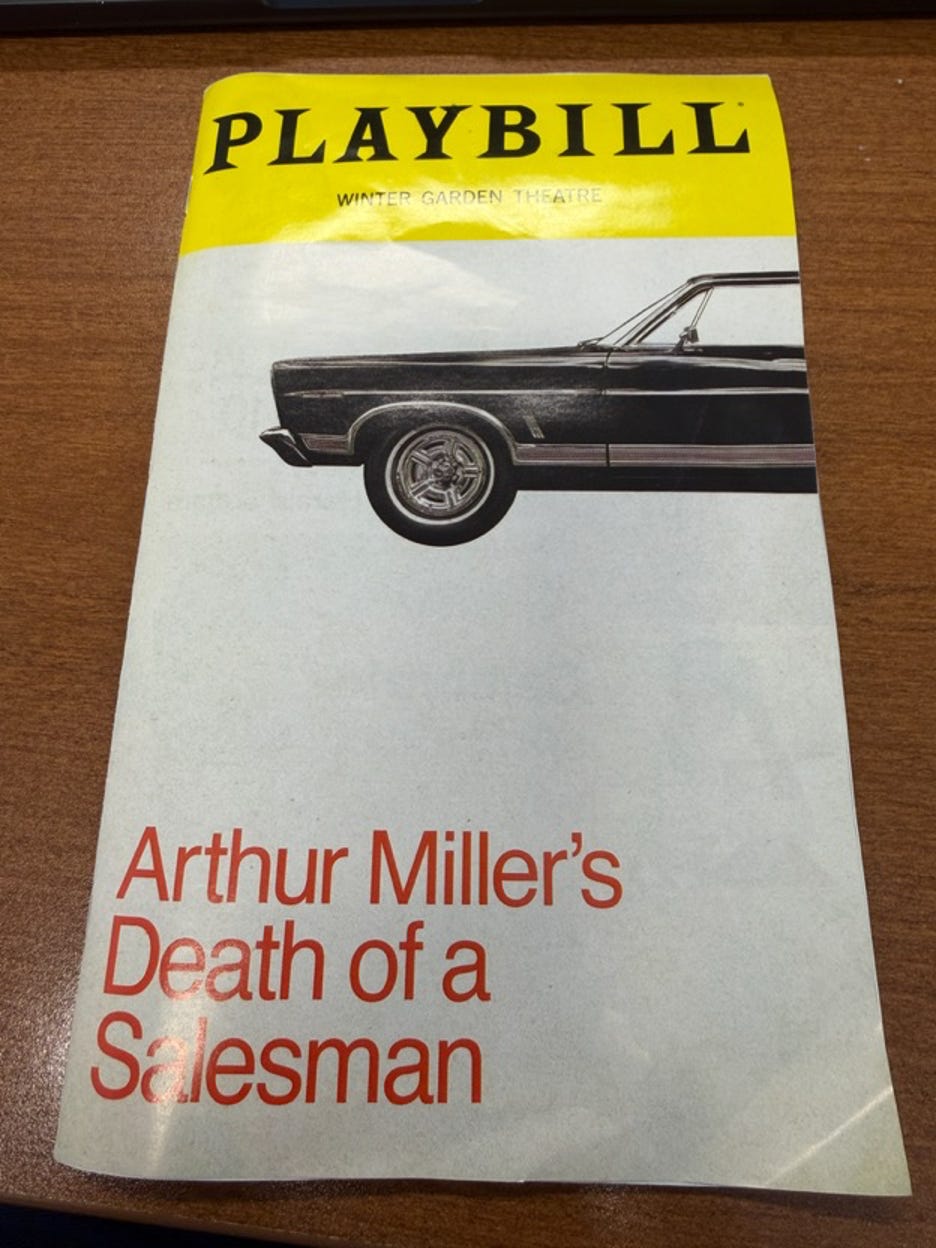
Review of Arthur Miller’s “Death of a Salesman,” Performed at the Winter Garden Theater, New York City, Friday, April 10, 2026
I was not impressed. Oh, the acting was fine; and the play is “a classic” for good reason. So why did I feel, in a word, “Eh”? Well, we know how it’s going to end; even the first word of the title gives that away. The descent of the protagonist, Willy Loman, into terminal disappointment simply did not feel “dramatic” (although the music tried to be). The expression “one-trick pony” comes to mind; Willy and his two sons, Biff and Happy, keep living failed fantasies; we get it. A deconstruction of the downsides and dangers of mid-centuryAmerican working-class life was probably more poignant, and somewhat revolutionary, when the play was first produced, in 1949. The production should have been shortened; some fat could have been trimmed, IMHO. I would not tell you not to see it, but don’t feel bad if you don’t. BTW, yes, Marilyn Monroe abandoned her marriage to Joe DiMaggio to marry Arthur Miller. This devastated Joe, who never married again, and whose dying words were, “I’ll finally get to see Marilyn.” Miller and Marilyn divorced after five years. She died a year later of a barbiturate overdose, “probably a suicide.” And yes, Ross Miller, Wheatley Class of 1964, who grew up on Barnyard Lane, was Arthur Miller’s nephew. Finally, a word about the star, Nathan Lane. He says that when, at 21, he came out as gay to his mother, she said, “I’d rather you were dead.” His response was, “I knew you’d understand.” He was in fine form in the play, but that was not enough to carry it out of “ho-hum” after all these years. Arthur Engoron (1967) Fan Mail1960 (Joanne Festa) - “I enjoy the Wheatley Newsletter, Art. Thanks.” 1960 (Raymond C. Roller) - ❤️ 1962 (Karen Strumpfler Tucker) - ❤️ 1963 (Keith Aufhauser) - ❤️ 1964 (Natalie Cobb Wentworth) - ❤️ 1971 (Andrew Rosen) - “Thanks for keeping us all connected.” 1975 (Wendy Zacharkow) - ❤️ 1983 (Monique Lazar Ruane) - ❤️ The Usual Words of WisdomAll underlined text is a link-to-a-link or a link-to-an-email-address. Clicking anywhere on underlined text, and then clicking on the text that pops up will get you to your on-line destination or will address an email. Thanks to our fabulous Webmaster, Keith Aufhauser (Class of 1963), you can regale yourself with the first 262 Wheatley School Alumni Association Newsletters (and much other Wheatley data and arcana) at our website: The Wheatley School Alumni Association Website Also thanks to Keith is our search engine, prominently displayed on our home page: type in a word or phrase and, wow!, you’ll find every place it exists in all previous Newsletters and other on-site material. I edit all submissions, even material in quotes, for clarity and concision, without any indication thereof. I cannot vouch for the accuracy of what people tell me, as TWSAA does not have a New Yorker style Fact-Checking Department. We welcome any and all text and photos relevant to The Wheatley School, 11 Bacon Road, Old Westbury, NY 11568, and the people who administered, taught, worked, performed, and/or studied there. Art Engoron, Class of 1967 ClosingThat’s it for The Wheatley School Alumni Association Newsletter # 264. Please send me your autobiography before someone else sends me your obituary. Art |


|
Arthur Friedrichs Engoron, Class of 1967 |